
A strong AI short drama outline turns one simple story idea into a sequence of episodes with a clear protagonist, escalating conflict, emotional turning points, and cliffhangers. Before generating characters, storyboards, or video clips, creators need to know what drives the story and what changes in each episode.
The goal is not to write every line of dialogue immediately. It is to build a practical story map that can later guide the script and production process.
This guide explains how to develop a one-sentence idea into an AI short drama outline, including a complete six-episode example.
What Is an AI Short Drama Outline?
An AI short drama outline is a structured plan for an episodic story that will later be turned into scripts, visual assets, storyboards, and generated video shots.
It usually defines:
- The protagonist
- The protagonist’s goal
- The central conflict
- The emotional stakes
- The key relationship
- The major turning points
- The purpose of each episode
- The hook and cliffhanger for each episode
An outline is more detailed than a premise but less detailed than a script.
A premise might say:
A delivery rider discovers that the luxury apartment she visits belongs to the family that stole her mother’s company.
An outline explains what she does with that information, who tries to stop her, how the conflict escalates, and why viewers should continue from one episode to the next.
Start With a Story Idea That Can Produce Multiple Conflicts
Not every interesting idea can sustain a short drama series.
A visual concept such as “a woman walks through a futuristic city” may produce attractive shots, but it does not yet create a dramatic story. A short drama idea needs a character who wants something and an obstacle that keeps creating new problems.
Before developing the outline, test the idea with five questions:
- Who makes the most important decisions?
- What does that character want now?
- Who or what prevents success?
- What will the character lose if they fail?
- Can the conflict create several reversals rather than one confrontation?
A useful story engine may be built around:
- Revenge
- Hidden identity
- Betrayal
- Forbidden love
- Family rivalry
- Competition
- Survival
- Social status
- A mystery
- A struggle for power
The genre is not enough by itself. “A revenge story” is still too broad. The idea becomes useful when it includes a specific protagonist, target, obstacle, and emotional contradiction.
For example:
A delivery rider enters a wealthy family’s home to recover evidence that they stole her mother’s company, but the only person willing to help her is the heir she believes caused the betrayal.
This version can create repeated conflict because the protagonist needs the help of someone she does not trust.
Step 1: Define the Protagonist
The audience needs one central character to follow.
Write down:
- Who the protagonist is
- What their life looks like at the beginning
- What they want
- What they fear
- What they are willing to risk
- What they still misunderstand
For the example story:
Protagonist: Maya Chen, a 25-year-old delivery rider whose mother lost her company after being accused of fraud.
External goal: Find the original ownership agreement hidden inside the Zhao family estate.
Internal need: Learn that proving the truth is different from punishing everyone connected to the betrayal.
Fear: Becoming powerless like she felt when her family collapsed.
Contradiction: She wants justice but is prepared to manipulate an innocent person to obtain it.
This contradiction gives the character room to change. Without it, the story may become a simple sequence of obstacles.
If the protagonist still feels unclear, use How to Find the Dramatic Spine of a Novel Before AI Adaptation to identify the character, goal, conflict, emotional engine, and transformation.
Step 2: Define the Central Conflict
The central conflict should remain active across the series.
In the example:
- Maya needs access to the Zhao estate.
- The family security director suspects her identity.
- The heir, Daniel Zhao, can help her enter restricted areas.
- Maya believes Daniel’s father destroyed her family.
- Daniel has his own reason to investigate the old agreement.
This creates several sources of pressure:
- Maya must hide her identity.
- She must decide whether Daniel can be trusted.
- The family is actively protecting the secret.
- The evidence may prove something Maya does not want to believe.
When defining the central conflict, avoid an obstacle that disappears after one scene. The best short drama conflicts create new choices, reversals, alliances, discoveries, and consequences.
Step 3: Establish the Emotional Stakes
Plot explains what happens. Emotional stakes explain why the audience should care.
Ask:
- What relationship matters most?
- What belief will the protagonist have to question?
- What does success cost?
- What personal loss would hurt more than losing the external goal?
For Maya, recovering the agreement matters because it could restore her mother’s name. But the emotional story becomes stronger when success threatens her growing trust in Daniel.
The central emotional question becomes:
Can Maya accept Daniel’s help without becoming the kind of person she believes his family to be?
This question connects the revenge plot to a relationship and a character transformation.
Step 4: Write the Dramatic Spine
The dramatic spine is one sentence that connects the protagonist, goal, opposition, emotional stakes, and transformation.
Use this template:
A [protagonist] must [goal], but [main obstacle], forcing them to choose between [external objective] and [emotional need].
For the example:
A delivery rider enters a powerful family’s estate to recover evidence that could clear her mother’s name, but her only ally is the heir she planned to deceive, forcing her to choose between revenge and the truth.
Use this sentence to evaluate every major episode idea.
Ask:
- Does the episode move Maya closer to or farther from the evidence?
- Does it increase the danger of her identity being exposed?
- Does it change her relationship with Daniel?
- Does it reveal information that affects the final choice?
If an episode does none of these things, it may not belong in the series.
Step 5: Identify the Major Turning Points
Before dividing the story into episodes, list the moments that change the situation.
For example:
- Maya recognizes the Zhao family crest at the delivery address.
- She learns that the original agreement may still exist.
- Daniel catches her searching the estate.
- Daniel offers to help instead of exposing her.
- Maya discovers evidence that Daniel’s father was not the only person involved.
- The security director identifies Maya.
- Daniel learns that Maya has been using him.
- Maya finds the agreement but realizes it implicates someone close to her mother.
- She must choose whether to release incomplete evidence or uncover the full truth.
These turning points form the skeleton of the series.
Do not divide the story into episodes too early. First determine what changes. Then group those changes into dramatic viewing units.
Step 6: Build Each Episode Around One Dramatic Question
Every episode should have one primary question.
Examples:
- Can Maya enter the estate without revealing why she is there?
- Will Daniel expose her after catching her in the archive room?
- Can they retrieve the security footage before it is erased?
- Will Maya tell Daniel the truth before the family identifies her?
A practical episode structure is:
Hook → Goal → Resistance → Escalation → Turning point → Cliffhanger
The hook creates immediate curiosity. The goal gives the episode direction. Resistance creates drama. The turning point changes the situation. The cliffhanger creates a new question.
For a more detailed episode-planning method, see How to Create Episode Outlines From a Novel for AI Short Drama.
Step 7: Add Hooks and Cliffhangers
Short drama episodes need strong entry and exit points.
An opening hook may:
- Begin during a confrontation
- Reveal an unusual situation
- Show a consequence before explaining its cause
- Introduce a secret
- Force the protagonist to make an immediate choice
A cliffhanger may:
- Reveal hidden information
- Reverse the balance of power
- Expose a lie
- Introduce a new threat
- Force an irreversible decision
- Change an important relationship
Avoid ending an episode only because a scene has reached a convenient length.
Weak ending:
Maya walks toward the archive room.
Stronger ending:
Maya opens the archive room and finds Daniel holding the document she came to steal.
The stronger version changes the situation and creates an immediate next question.
Complete Example: A Six-Episode AI Short Drama Outline
Episode 1: The Delivery
Hook: Maya arrives at a luxury estate and sees the crest from the company that destroyed her mother.
Goal: Find out whether the Zhao family still keeps records from the old acquisition.
Conflict: Security prevents delivery workers from entering the main house.
Turning point: Daniel Zhao recognizes Maya’s surname but does not explain why.
Cliffhanger: Maya sees a photograph of her mother inside Daniel’s private office.
Episode 2: The Photograph
Hook: Maya secretly photographs the image before Daniel returns.
Goal: Learn why Daniel’s family had a relationship with her mother.
Conflict: Daniel questions her interest in the photograph.
Turning point: He reveals that the original ownership agreement may still be inside the estate.
Cliffhanger: Daniel says, “If you want the truth about your mother, stop pretending you came here by accident.”
Episode 3: The Offer
Hook: Daniel confronts Maya about her identity.
Goal: Prevent him from reporting her to the family.
Conflict: Daniel offers access to the archive only if Maya shares everything she knows.
Turning point: Maya agrees but hides her plan to release the evidence publicly.
Cliffhanger: The security director watches their conversation through a hidden camera.
Episode 4: The Archive
Hook: Maya and Daniel enter the restricted archive during a family event.
Goal: Locate the original agreement before security completes its patrol.
Conflict: The archive index has been altered, and the expected file is missing.
Turning point: Maya finds a payment record connected to someone from her mother’s legal team.
Cliffhanger: The archive door locks, and the security director speaks through the intercom.
Episode 5: The Betrayal
Hook: The security director reveals that he knows Maya’s real identity.
Goal: Escape with the payment record.
Conflict: Daniel discovers that Maya planned to use him and publish the documents without verifying them.
Turning point: Daniel helps her escape but ends their alliance.
Cliffhanger: Maya reads the full payment record and sees her uncle’s signature.
Episode 6: The Choice
Hook: Maya confronts her uncle, who claims the payment protected her mother from a larger conspiracy.
Goal: Decide whether to publish the partial evidence or continue investigating.
Conflict: Publishing now could clear her mother’s name but falsely implicate Daniel.
Turning point: Maya chooses the full truth over immediate revenge.
Cliffhanger: Daniel receives an anonymous message containing the location of the missing agreement.
This outline does not contain every scene or line of dialogue. It gives the production a clear emotional and episodic direction before detailed scripting begins.
What to Record in Every Episode Outline
Use the following structure:
| Field | Purpose |
|---|---|
| Episode number | Keeps the series organized |
| Opening hook | Creates immediate curiosity |
| Character goal | Gives the episode direction |
| Main obstacle | Creates active conflict |
| New information | Changes what the audience understands |
| Emotional change | Advances the character or relationship |
| Turning point | Changes the situation |
| Cliffhanger | Creates a reason to continue |
| Required characters | Supports later asset planning |
| Required locations | Supports later scene planning |
| Important props | Prevents continuity problems |
Adding characters, locations, and props at the outline stage makes the later production process easier. It reveals which visual assets will need to remain consistent across episodes.
When Is the Outline Ready for Scriptwriting?
The outline is ready when:
- The protagonist has a specific goal.
- The central conflict can sustain multiple episodes.
- Every episode changes the situation.
- The emotional relationship develops alongside the external plot.
- Major reveals are prepared before they occur.
- Episode endings create meaningful new questions.
- The final choice connects to the protagonist’s transformation.
The outline is not ready when episodes repeat the same confrontation, the protagonist remains passive, or cliffhangers depend on random events unrelated to earlier decisions.
Move From the Outline to AI Short Drama Production
Once the episode outline works, turn each episode into scenes and dialogue. Then identify recurring characters, locations, wardrobe versions, and important props before creating storyboards or generating video.
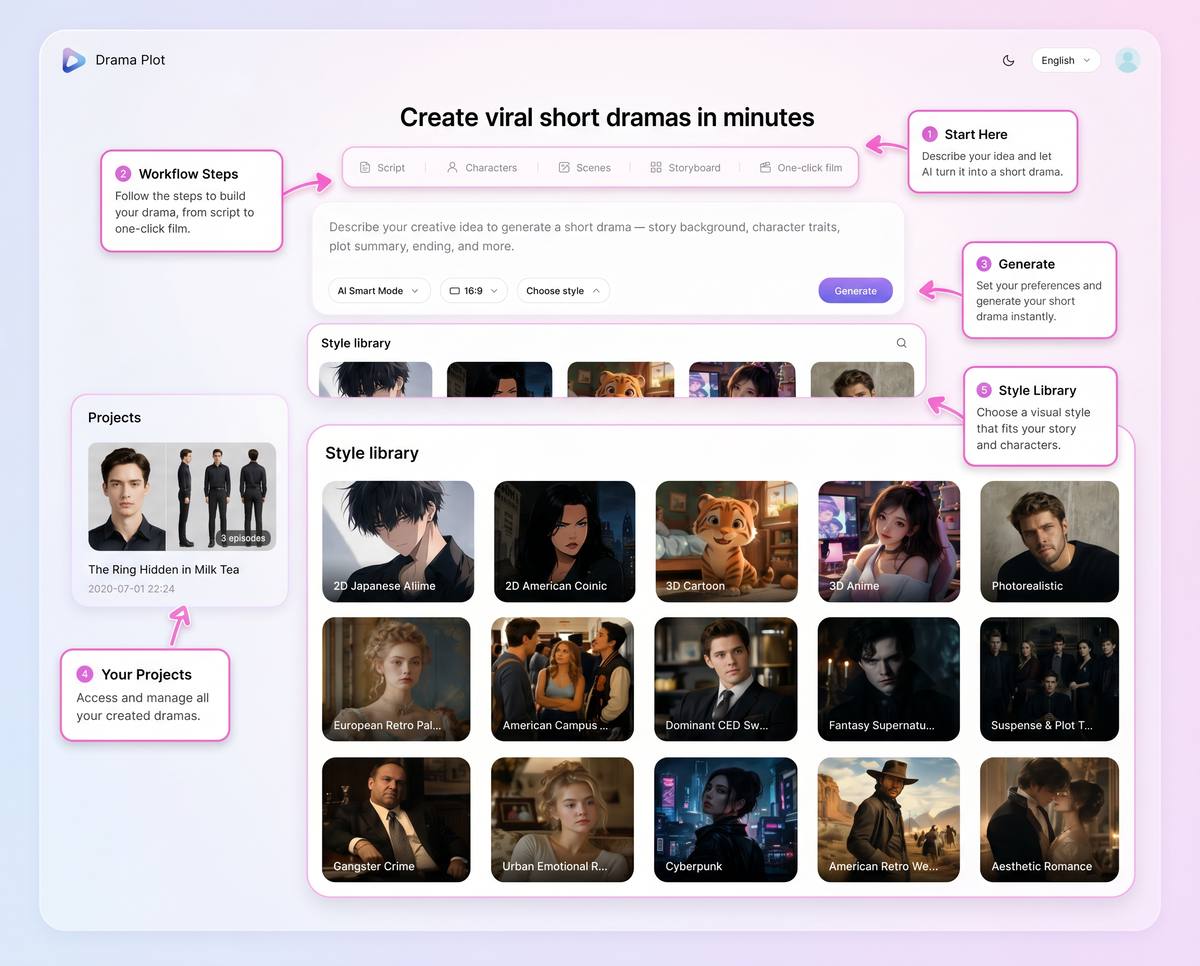
Drama Pilot can help develop a one-line idea into a synopsis, story background, character profiles, episode outlines, dialogue, and narration. The approved outline can then remain connected to the later character, scene, storyboard, and video stages.
For the complete production process after outlining, read AI Short Drama Workflow: From Story Idea to Complete Episode.
Common Story-Outline Mistakes
Introducing Too Many Characters
Every additional character creates new writing and visual-continuity requirements. Combine supporting roles when they perform the same story function.
Treating Setup as an Episode
Background information alone does not create drama. Each episode needs a goal, resistance, and change.
Repeating the Same Conflict
If every episode contains another argument about the same issue, the story is not escalating. Add discoveries, reversals, consequences, and changing alliances.
Using Random Cliffhangers
A surprise has more impact when it grows from earlier choices. Avoid unrelated accidents or new villains introduced only to end an episode.
Starting Visual Generation Before the Outline Works
Attractive images cannot repair weak episode structure. Approve the story direction before investing in recurring assets and video shots.
Frequently Asked Questions
How detailed should an AI short drama outline be?
It should define the hook, goal, conflict, turning point, emotional change, and cliffhanger for every episode. It does not need complete dialogue or shot-level instructions.
How many episodes should I plan?
Plan only as many episodes as the central conflict can support without repetition. A focused pilot of three to six episodes is more useful than a long season built around weak or repeated events.
Should one novel chapter become one short drama episode?
Not necessarily. Episodes should follow dramatic turning points rather than chapter boundaries. Several chapters may become one episode, while one event-heavy chapter may become several episodes.
Can AI create the episode outline automatically?
AI can propose protagonists, conflicts, turning points, and episode structures. Human review is still needed to remove repetition, strengthen motivation, control pacing, and decide which emotional changes matter.
What should I do after completing the outline?
Turn each episode into a scene-level script, establish reusable character and location references, create storyboards, and generate focused video shots according to the approved production plan.
Final Takeaway
One story idea becomes an AI short drama when it is organized around a protagonist, a repeatable central conflict, emotional stakes, turning points, and episode-level questions.
Do not begin by generating every character or video clip. First define what the protagonist wants, how the conflict escalates, what changes in each episode, and why viewers should continue.
A strong outline gives every later production decision a purpose.